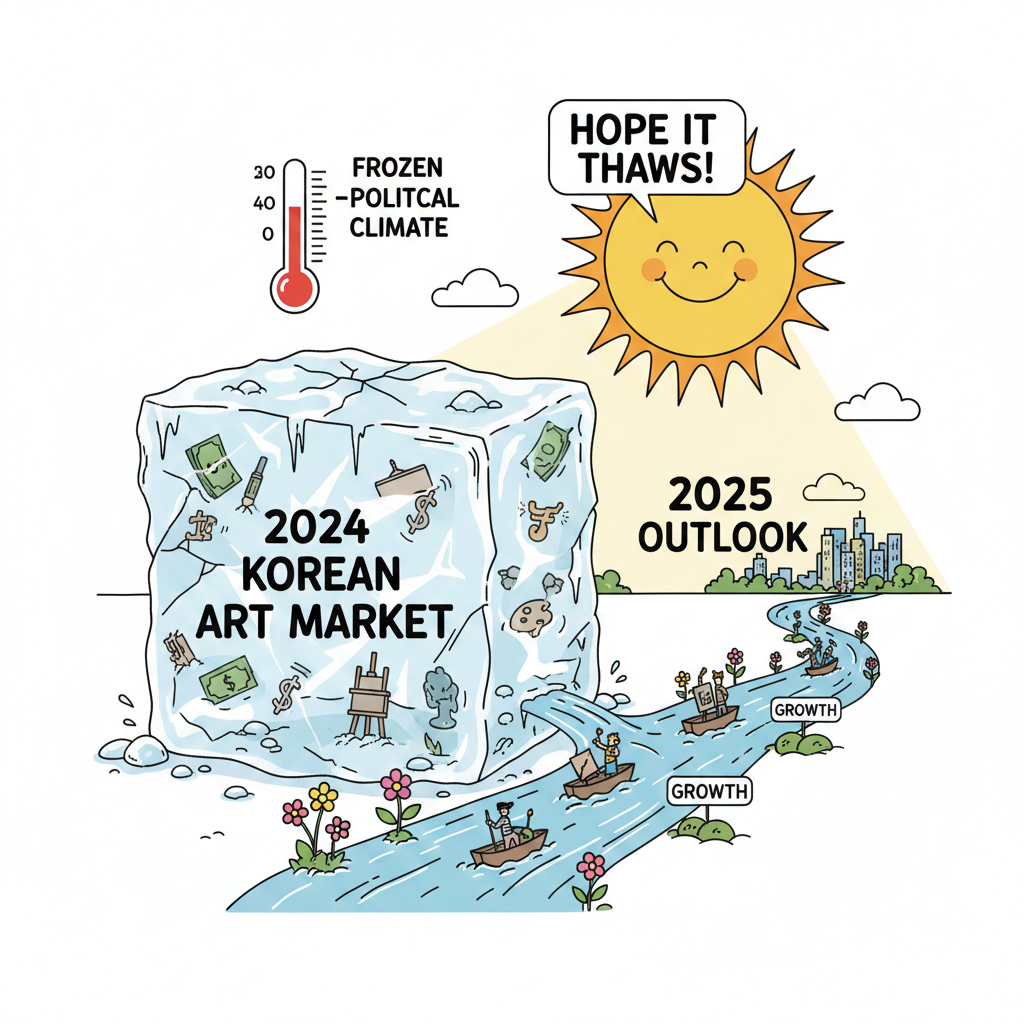
This year, Korea’s art market endured not only the global economic slowdown but also a distinctly domestic chill: political uncertainty. While the art world often seeks to maintain a measured distance from politics, 2025 proved to be a year in which that distance collapsed.
Persistent political tensions and policy uncertainty weighed heavily on capital flows, and the effects were quickly felt in collector psychology. Major collectors postponed purchases, mid-level buyers retreated into wait-and-see mode, and risk appetite across the market diminished. In a climate where art is increasingly viewed through the lens of asset management, political instability became one of the fastest ways to freeze cultural spending.
The impact rippled through every layer of the ecosystem. Auction houses reduced consignments, galleries shifted their focus from growth to survival, and experimental exhibitions introducing emerging artists gave way to safer, more conservative programming centered on already validated names. While such caution may be understandable in the short term, it raises longer-term concerns about the erosion of diversity and creative risk-taking.
by ChangSoon
The sense of stagnation deepened as political issues dominated public discourse and cultural policy slipped down the list of priorities. Budget discussions sidelined the arts, while museums, residencies, and nonprofit spaces entered a prolonged holding pattern. Art is often described as a mirror of society, and this year, that reflection appeared unusually cold and rigid.
Yet the market did not come to a complete standstill. Some collectors viewed the downturn as a period of recalibration, focusing on long-term value rather than short-term signals. Certain galleries strengthened ties with overseas markets, seeking stability beyond domestic borders. As history has shown, periods of contraction often reveal which institutions and individuals possess genuine resilience and discernment.
Attention now turns to the year ahead. What the art market needs is neither another speculative boom nor artificial stimulus, but a more predictable political environment, consistent cultural policy, and a broader recognition of art as a social asset rather than a discretionary expense. Markets recover not through optimism alone, but through stability.
In the coming year, one can only hope that politics becomes a quieter backdrop rather than a disruptive force. If a warmer political climate emerges, the embers that survived this year’s cold may yet reignite. Korea’s art market still holds considerable potential — and as always, it responds first and most sensitively to its surrounding environment.
If this year felt like a harsh winter, perhaps next year can mark the beginning of a long-awaited spring.
SayArt.net Sayart sayart2022@gmail.com
This year, Korea’s art market endured not only the global economic slowdown but also a distinctly domestic chill: political uncertainty. While the art world often seeks to maintain a measured distance from politics, 2025 proved to be a year in which that distance collapsed.
Persistent political tensions and policy uncertainty weighed heavily on capital flows, and the effects were quickly felt in collector psychology. Major collectors postponed purchases, mid-level buyers retreated into wait-and-see mode, and risk appetite across the market diminished. In a climate where art is increasingly viewed through the lens of asset management, political instability became one of the fastest ways to freeze cultural spending.
The impact rippled through every layer of the ecosystem. Auction houses reduced consignments, galleries shifted their focus from growth to survival, and experimental exhibitions introducing emerging artists gave way to safer, more conservative programming centered on already validated names. While such caution may be understandable in the short term, it raises longer-term concerns about the erosion of diversity and creative risk-taking.
by ChangSoon
The sense of stagnation deepened as political issues dominated public discourse and cultural policy slipped down the list of priorities. Budget discussions sidelined the arts, while museums, residencies, and nonprofit spaces entered a prolonged holding pattern. Art is often described as a mirror of society, and this year, that reflection appeared unusually cold and rigid.
Yet the market did not come to a complete standstill. Some collectors viewed the downturn as a period of recalibration, focusing on long-term value rather than short-term signals. Certain galleries strengthened ties with overseas markets, seeking stability beyond domestic borders. As history has shown, periods of contraction often reveal which institutions and individuals possess genuine resilience and discernment.
Attention now turns to the year ahead. What the art market needs is neither another speculative boom nor artificial stimulus, but a more predictable political environment, consistent cultural policy, and a broader recognition of art as a social asset rather than a discretionary expense. Markets recover not through optimism alone, but through stability.
In the coming year, one can only hope that politics becomes a quieter backdrop rather than a disruptive force. If a warmer political climate emerges, the embers that survived this year’s cold may yet reignite. Korea’s art market still holds considerable potential — and as always, it responds first and most sensitively to its surrounding environment.
If this year felt like a harsh winter, perhaps next year can mark the beginning of a long-awaited spring.
Warning: Trying to access array offset on value of type bool in /home/sayart/public_html/_libs/smarty/templates_c/103e99f6d7d08ee6b6541efd32c0ef2f33076acc_0.file.news_3t_view.tpl.php on line 56
Warning: Trying to access array offset on value of type bool in /home/sayart/public_html/_libs/smarty/templates_c/103e99f6d7d08ee6b6541efd32c0ef2f33076acc_0.file.news_3t_view.tpl.php on line 59