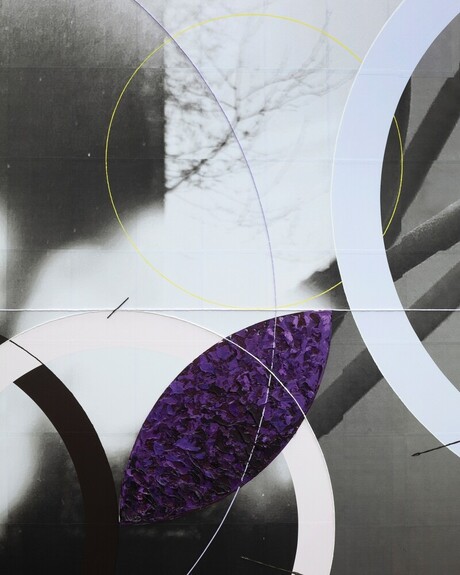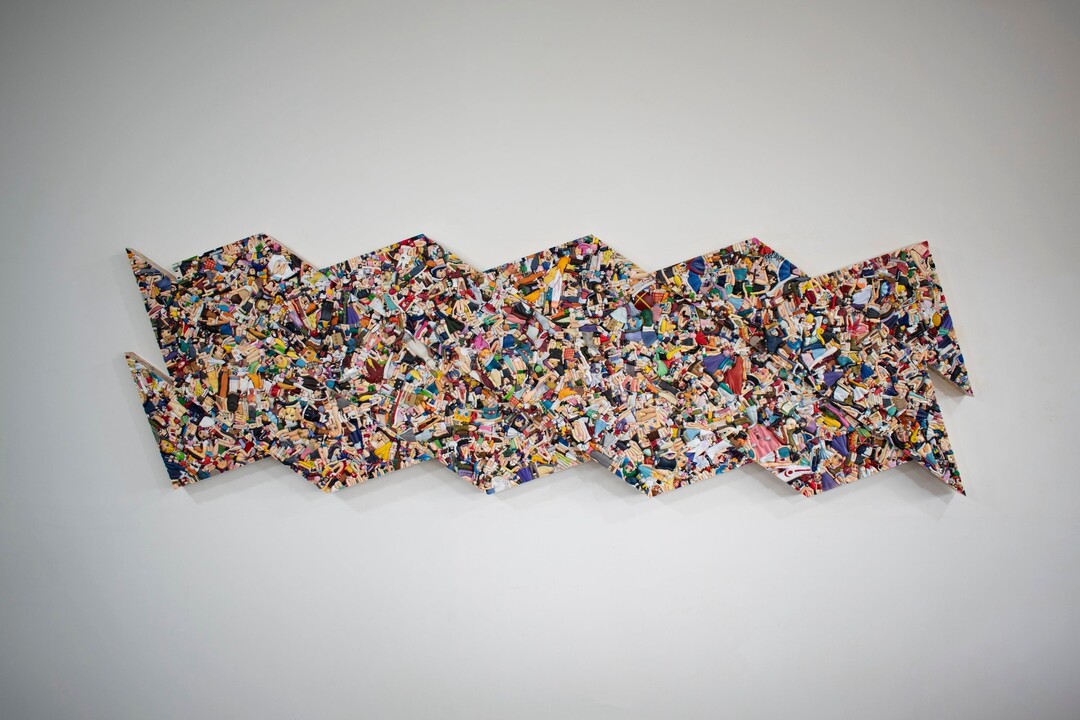
three, “77V type 18.85kg TRANS” (2026), aluminum, PVC, figurines and wood. Courtesy of Whitestone Gallery.
In “3234g,” a circular sculpture 60 centimeters across, the Japanese artist collective three has melted toy figurines to different degrees. The piece is among the works in the group’s first solo exhibition in Korea, “three is a magic number 23,” on view through November 29 at Whitestone Gallery in Seoul.
The collective works with mass-produced figures of characters from animation and manga. Before the artists start cutting and heating the plastic, a face or costume is enough to identify its owner. Some of those features survive in the finished pieces. Elsewhere the cuts expose sections of color from which it is difficult to reconstruct a character.
For “3234g” (2026), three varied how much the figures melt into one another. The gallery traces the idea to a feature of virtual environments, where one object can appear to pass into another. Here the different cross-sections give the surface of the relief a changing texture within a depth of four centimeters.
Another series starts with the measurements of television and phone screens. The artists use the dimensions of actual devices to set the format of the “V” works. In the newer “TRANS” pieces, they cut across the surface several times and shift the sections by equal increments. The resulting offsets give the front and back different profiles.
Among the works in Seoul is “77V type 18.85kg TRANS” (2026), made from aluminum, PVC, figurines and wood. Other titles record weights in grams, including “5679g” and “6344g.” Whitestone is presenting earlier and new pieces together at its Yongsan gallery at 70 Sowol-ro.
[Sayart = Maria Kim]
At Whitestone Gallery, a circular relief and a series based on screen sizes show what happens when familiar characters are cut apart.
three, “77V type 18.85kg TRANS” (2026), aluminum, PVC, figurines and wood. Courtesy of Whitestone Gallery.
In “3234g,” a circular sculpture 60 centimeters across, the Japanese artist collective three has melted toy figurines to different degrees. The piece is among the works in the group’s first solo exhibition in Korea, “three is a magic number 23,” on view through November 29 at Whitestone Gallery in Seoul.
The collective works with mass-produced figures of characters from animation and manga. Before the artists start cutting and heating the plastic, a face or costume is enough to identify its owner. Some of those features survive in the finished pieces. Elsewhere the cuts expose sections of color from which it is difficult to reconstruct a character.
For “3234g” (2026), three varied how much the figures melt into one another. The gallery traces the idea to a feature of virtual environments, where one object can appear to pass into another. Here the different cross-sections give the surface of the relief a changing texture within a depth of four centimeters.
Another series starts with the measurements of television and phone screens. The artists use the dimensions of actual devices to set the format of the “V” works. In the newer “TRANS” pieces, they cut across the surface several times and shift the sections by equal increments. The resulting offsets give the front and back different profiles.
Among the works in Seoul is “77V type 18.85kg TRANS” (2026), made from aluminum, PVC, figurines and wood. Other titles record weights in grams, including “5679g” and “6344g.” Whitestone is presenting earlier and new pieces together at its Yongsan gallery at 70 Sowol-ro.
[Sayart = Maria Kim]