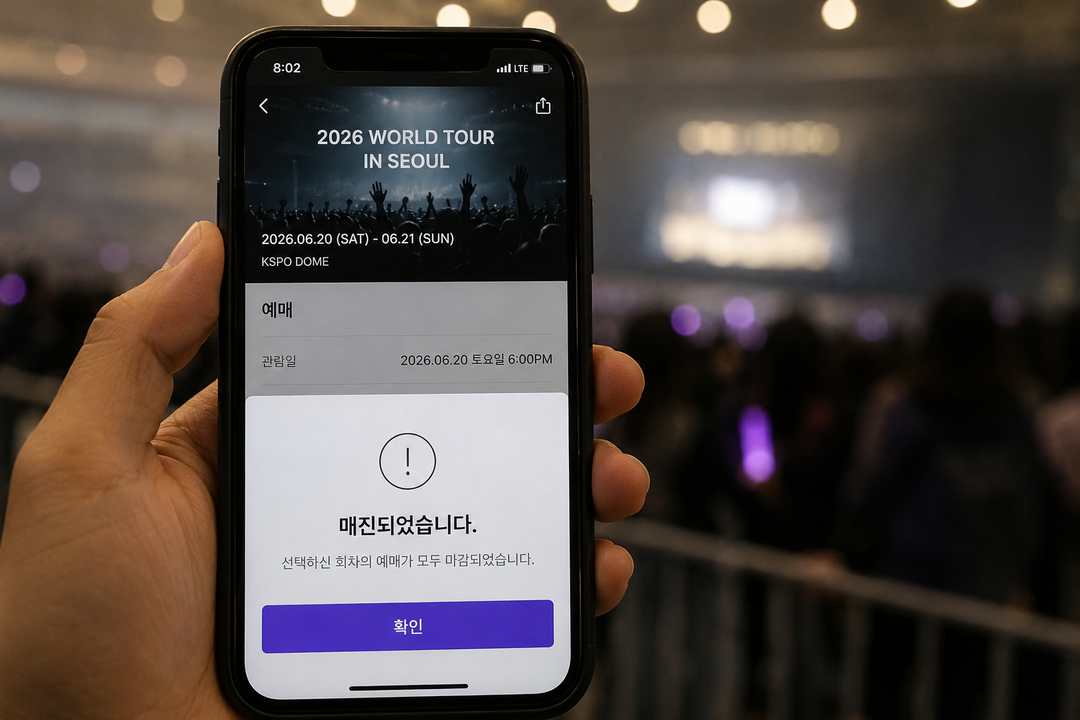
For many fans, a K-pop concert begins long before the artist steps on stage. It begins with a waiting room, a frozen screen, a queue number, a failed payment, and the quiet frustration of watching tickets disappear in seconds.
This has become one of the most familiar rituals in K-pop. The global success of the industry has made concerts larger, tours more ambitious and fandoms more international. Yet the ticketing experience often remains one of the weakest parts of the system.
In South Korea, the problem has become serious enough to invite stronger legal action. The Ministry of Culture, Sports and Tourism recently referred 15 people to police over alleged resale of K-pop concert and sports tickets at inflated prices, with some tickets reportedly marked up to eight times their original price. From August 28, South Korea is also expected to impose much heavier penalties on ticket scalping, including fines of up to 50 times the resale price.
The issue is not only economic. It is cultural.
A concert ticket is not just a product. For fans, it can mean months of anticipation, savings, travel plans, emotional preparation and the chance to share a moment with an artist and a community. When that ticket is captured by automated systems, resold at extreme prices or turned into a speculative asset, the relationship between artist and fan is distorted.
K-pop has built much of its power on intimacy. Fan chants, light sticks, livestreams, fan platforms, behind-the-scenes content and direct messaging services all create the feeling that fans are close to the artist’s journey. But if the live stage becomes accessible mainly to those who can pay inflated resale prices, that intimacy becomes fragile.
The industry cannot celebrate sold-out stadiums while ignoring how fans reach those seats.
Of course, demand will always exceed supply for major artists. No ticketing system can make every fan happy. But there is a difference between scarcity and exploitation. Scarcity is inevitable when millions want to see the same artist. Exploitation happens when that desire is manipulated by bots, bulk buyers and resale markets that treat fandom as a profit machine.
This is why stronger penalties matter. But law alone will not solve the problem. Entertainment companies, ticketing platforms and venues must also take responsibility. Real-name ticketing, stricter identity checks, delayed mobile ticket transfers, official resale channels, clearer refund systems and stronger anti-bot technology should not be treated as optional services. They are now part of concert ethics.
K-pop’s next stage will not be measured only by Billboard rankings, YouTube views or stadium attendance. It will also be measured by how responsibly the industry manages the communities that made those achievements possible.
Fans are not simply consumers at the end of a sales funnel. They are the cultural force that carries K-pop across languages, borders and platforms. Protecting them from predatory ticket markets is not a minor administrative issue. It is a matter of trust.
A fair ticket does not guarantee a perfect concert.
But without fair access, even the brightest stage begins with disappointment.
[Sayart = Maria Kim]
sayart2022@gmail.com
Fair access to concerts must become part of the K-pop industry’s responsibility
For many fans, a K-pop concert begins long before the artist steps on stage. It begins with a waiting room, a frozen screen, a queue number, a failed payment, and the quiet frustration of watching tickets disappear in seconds.
This has become one of the most familiar rituals in K-pop. The global success of the industry has made concerts larger, tours more ambitious and fandoms more international. Yet the ticketing experience often remains one of the weakest parts of the system.
In South Korea, the problem has become serious enough to invite stronger legal action. The Ministry of Culture, Sports and Tourism recently referred 15 people to police over alleged resale of K-pop concert and sports tickets at inflated prices, with some tickets reportedly marked up to eight times their original price. From August 28, South Korea is also expected to impose much heavier penalties on ticket scalping, including fines of up to 50 times the resale price.
The issue is not only economic. It is cultural.
A concert ticket is not just a product. For fans, it can mean months of anticipation, savings, travel plans, emotional preparation and the chance to share a moment with an artist and a community. When that ticket is captured by automated systems, resold at extreme prices or turned into a speculative asset, the relationship between artist and fan is distorted.
K-pop has built much of its power on intimacy. Fan chants, light sticks, livestreams, fan platforms, behind-the-scenes content and direct messaging services all create the feeling that fans are close to the artist’s journey. But if the live stage becomes accessible mainly to those who can pay inflated resale prices, that intimacy becomes fragile.
The industry cannot celebrate sold-out stadiums while ignoring how fans reach those seats.
Of course, demand will always exceed supply for major artists. No ticketing system can make every fan happy. But there is a difference between scarcity and exploitation. Scarcity is inevitable when millions want to see the same artist. Exploitation happens when that desire is manipulated by bots, bulk buyers and resale markets that treat fandom as a profit machine.
This is why stronger penalties matter. But law alone will not solve the problem. Entertainment companies, ticketing platforms and venues must also take responsibility. Real-name ticketing, stricter identity checks, delayed mobile ticket transfers, official resale channels, clearer refund systems and stronger anti-bot technology should not be treated as optional services. They are now part of concert ethics.
K-pop’s next stage will not be measured only by Billboard rankings, YouTube views or stadium attendance. It will also be measured by how responsibly the industry manages the communities that made those achievements possible.
Fans are not simply consumers at the end of a sales funnel. They are the cultural force that carries K-pop across languages, borders and platforms. Protecting them from predatory ticket markets is not a minor administrative issue. It is a matter of trust.
A fair ticket does not guarantee a perfect concert.
But without fair access, even the brightest stage begins with disappointment.
[Sayart = Maria Kim]
sayart2022@gmail.com