Umar Rashid Examines Power and Spectacle Through Fictional History
Published September 2, 2026 09:42 PM
Jason Yim
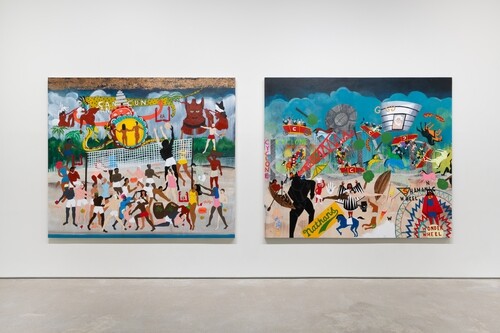
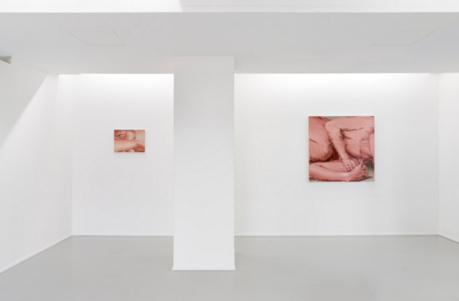
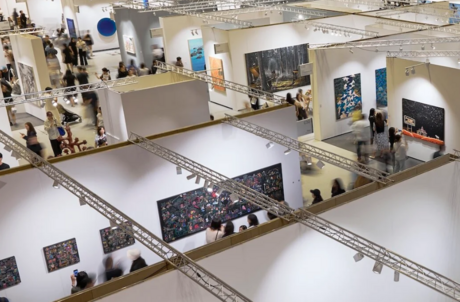
The installation view of the exhibition, Courtesy of Leeanh Gallery
American artist Umar Rashid is presenting “The Epoch of Totalitarianism IV: The Slow Motion Chaos of Bread and Circuses” at Leeahn Gallery Seoul.
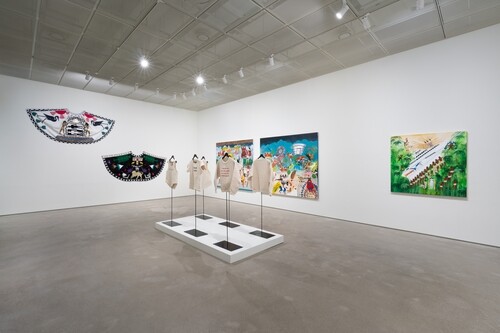
The exhibition is the fourth chapter of Rashid’s 12-part narrative series “The Epoch of Totalitarianism.” Paintings, installations and textile works examine how tourism, sport, leisure, branding and entertainment intersect with systems of power and control.
For roughly two decades, Rashid has developed an alternative history that combines documented events with fictional nations, characters, wars and mythologies. Central to this universe is the Frenglish Empire, an invented colonial power formed through the merging of France and England.
His compositions draw on illuminated manuscripts, miniature painting and Japanese ukiyo-e. Historical figures, mythological beings, corporate logos and popular-culture icons appear together within flat fields of saturated color and sharply defined outlines.
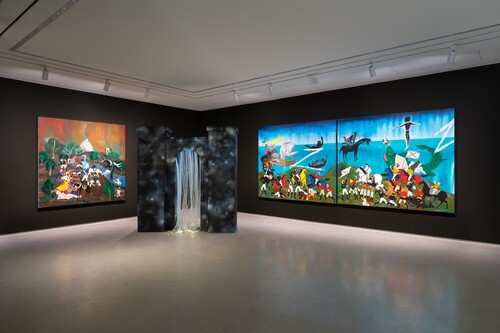
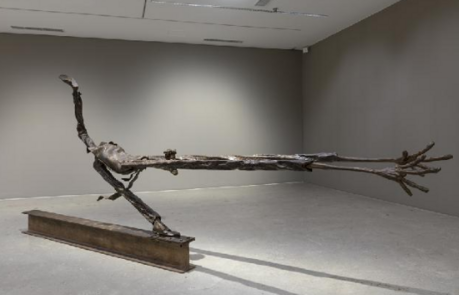
The installation view of the exhibition, Courtesy of Leeanh Gallery
The phrase “bread and circuses” refers to the political use of food and entertainment to divert public attention. Rashid places conflict, colonial ambition and violence within tourist destinations, amusement parks and resorts, examining how leisure and political authority may occupy the same space.
“Ishtar Gate” combines references to the ancient Babylonian structure with the science-fiction film “Stargate.” Positioned as a threshold, the installation introduces viewers to the artist’s fictional historical world.
“The Battle of Long Beach” brings together Zorro, Michael Jackson and the hip-hop group N.W.A. within an imagined battle involving the Spanish Empire in Long Beach, California. A vehicle arriving from space further disrupts the work’s historical setting.
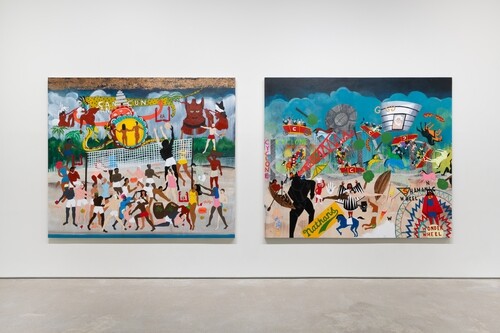
The installation view of the exhibition, Courtesy of Leeanh Gallery
“The Evian Incident,” which also serves as the exhibition’s poster image, depicts skiers and revelers alongside wolves, a mammoth, a spacecraft, ancient objects and mythological figures. Signs of conflict interrupt what initially resembles a peaceful resort scene.
Born in Chicago and based in Los Angeles, Rashid works across painting, drawing, sculpture and writing. His practice considers how colonialism, race, class and political power shape the construction of history. The exhibition continues through Oct. 17.
SayArt.net Jason Yim yimjongho1969@gmail.com
Part IV of “The Epoch of Totalitarianism” runs at Leeahn Gallery Seoul through Oct. 17The installation view of the exhibition, Courtesy of Leeanh Gallery
American artist Umar Rashid is presenting “The Epoch of Totalitarianism IV: The Slow Motion Chaos of Bread and Circuses” at Leeahn Gallery Seoul.
The exhibition is the fourth chapter of Rashid’s 12-part narrative series “The Epoch of Totalitarianism.” Paintings, installations and textile works examine how tourism, sport, leisure, branding and entertainment intersect with systems of power and control.
For roughly two decades, Rashid has developed an alternative history that combines documented events with fictional nations, characters, wars and mythologies. Central to this universe is the Frenglish Empire, an invented colonial power formed through the merging of France and England.
His compositions draw on illuminated manuscripts, miniature painting and Japanese ukiyo-e. Historical figures, mythological beings, corporate logos and popular-culture icons appear together within flat fields of saturated color and sharply defined outlines.
The installation view of the exhibition, Courtesy of Leeanh Gallery
The phrase “bread and circuses” refers to the political use of food and entertainment to divert public attention. Rashid places conflict, colonial ambition and violence within tourist destinations, amusement parks and resorts, examining how leisure and political authority may occupy the same space.
“Ishtar Gate” combines references to the ancient Babylonian structure with the science-fiction film “Stargate.” Positioned as a threshold, the installation introduces viewers to the artist’s fictional historical world.
“The Battle of Long Beach” brings together Zorro, Michael Jackson and the hip-hop group N.W.A. within an imagined battle involving the Spanish Empire in Long Beach, California. A vehicle arriving from space further disrupts the work’s historical setting.
The installation view of the exhibition, Courtesy of Leeanh Gallery
“The Evian Incident,” which also serves as the exhibition’s poster image, depicts skiers and revelers alongside wolves, a mammoth, a spacecraft, ancient objects and mythological figures. Signs of conflict interrupt what initially resembles a peaceful resort scene.
Born in Chicago and based in Los Angeles, Rashid works across painting, drawing, sculpture and writing. His practice considers how colonialism, race, class and political power shape the construction of history. The exhibition continues through Oct. 17.
Warning: Trying to access array offset on value of type bool in /home/sayart/public_html/_libs/smarty/templates_c/103e99f6d7d08ee6b6541efd32c0ef2f33076acc_0.file.news_3t_view.tpl.php on line 56
Warning: Trying to access array offset on value of type bool in /home/sayart/public_html/_libs/smarty/templates_c/103e99f6d7d08ee6b6541efd32c0ef2f33076acc_0.file.news_3t_view.tpl.php on line 59