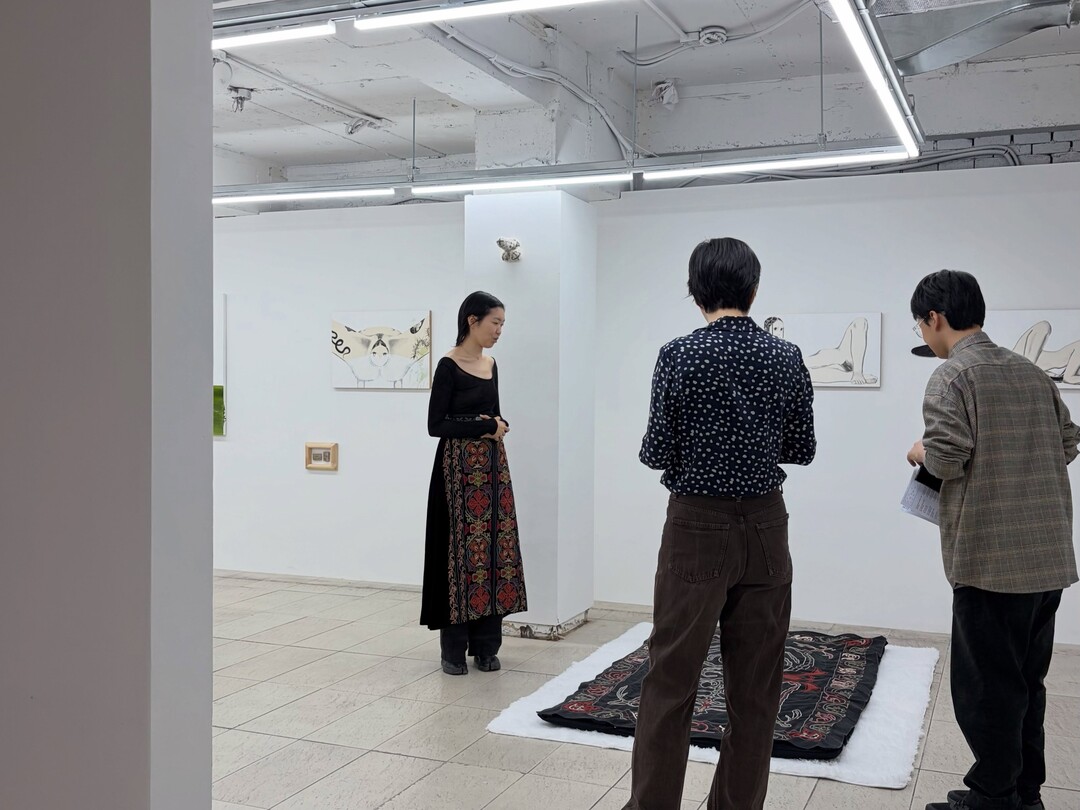
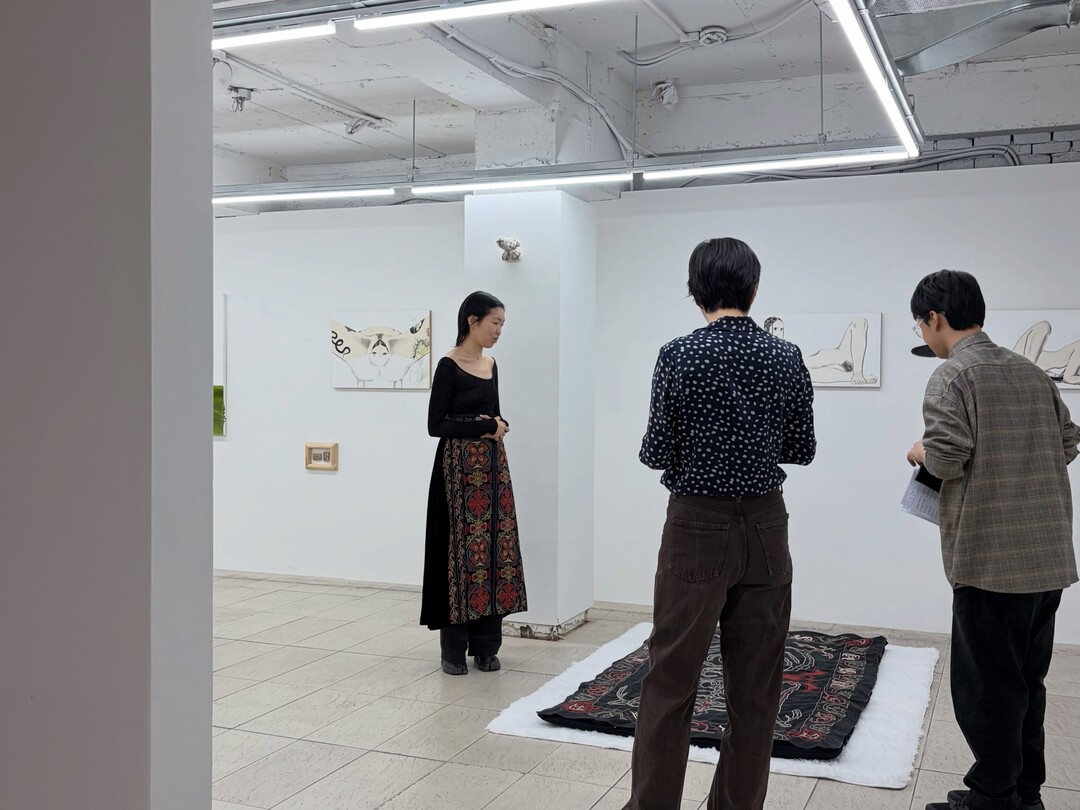
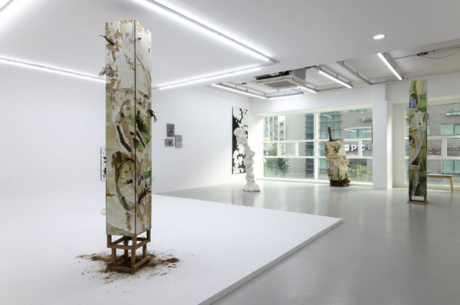
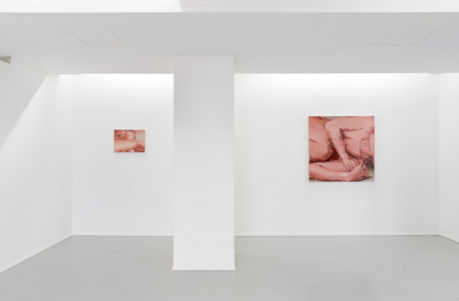
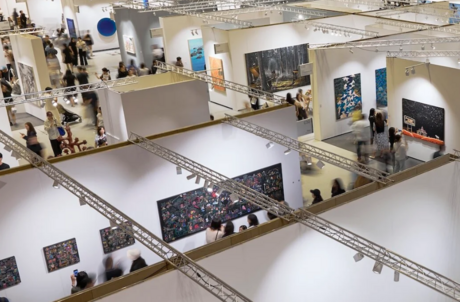
The view of the opening reception for King Kanna’s solo exhibition, Furry Bodies Shaped by Lines. Courtesy of the artist's Instagram
Artist King Kanna is presenting the solo exhibition Furry Bodies Shaped by Lines at Gallery Iheng in Seoul through Nov. 14.
The exhibition brings together works produced between 2022 and 2026, including mixed-media paintings on paper, small ceramic sculptures and embroidered fabric. Across the different media, Kanna depicts bodies in which human and animal characteristics overlap.
The artist refers to these figures as chimeras. Their spines twist, hair covers their bodies and familiar anatomical features merge with animal forms. By making images that may initially appear uncomfortable, Kanna examines the standards through which certain bodies are considered natural, beautiful or acceptable.
This concern appeared in an early painting created for the artist’s undergraduate graduation review. The work portrayed a deer mother regarded as the ancestral figure of Kanna’s tribe. Reclining with tattoos and body hair, the goddess looked beyond the picture frame. The painting did not pass the review.
The experience raised a question that continues through the artist’s practice: whether discomfort belongs to an image itself or is produced by the viewer’s learned expectations.
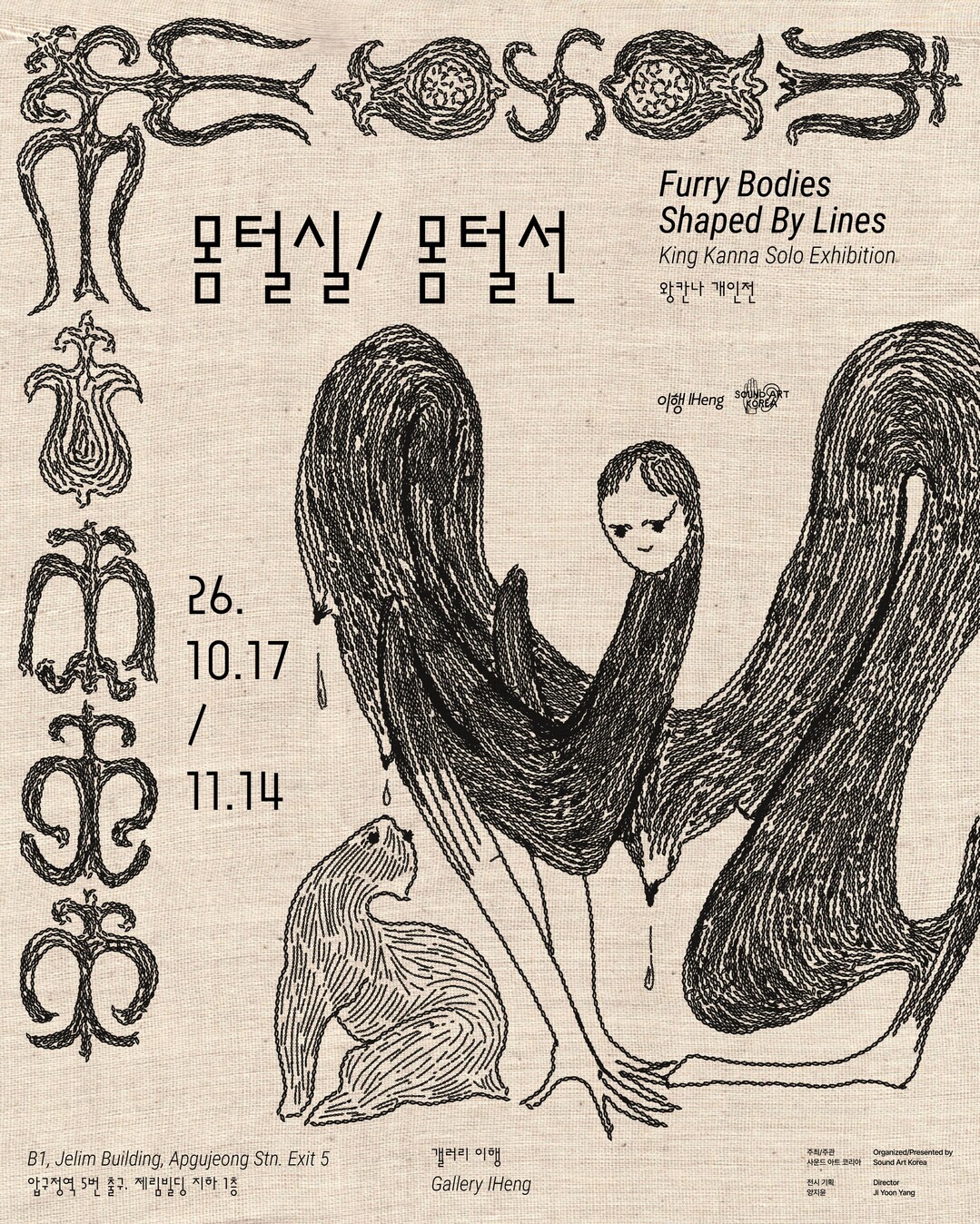
Kanna’s works on paper are largely monochromatic and constructed from repeated lines. Individual strokes accumulate into strands of hair, while the hair gradually establishes the contours of a body.
The emphasis on bodily hair challenges the smooth female body established as a convention in Western nude painting and repeated in contemporary animation and game characters. Within those visual traditions, removing hair separates the human body from the animal and also operates as a way of making a body appear conventionally feminine.
The poster of the exhibition, Courtesy of the artist's Instagram
The exhibition’s spatial arrangement brings the chimeras progressively closer to the viewer. Paper works surround the walls of the long gallery, while a shelf of ceramics crosses its centre. Embroidered fabric is placed on the floor at the innermost end.
The paintings are objects to be viewed, the ceramics can be held and the fabric suggests a surface on which a body might lie. As visitors move deeper into the space, the works shift from distant images toward forms related more directly to touch and physical presence.
Dozens of palm-sized ceramic figures crouch, sit, nurse and sleep on the central shelf. Cream-coloured sculptures assume poses resembling sphinxes, while curved shapes based on ram-horn motifs can also be read as curled animals.
Kanna gives some of the ceramic works names associated with nomadic household objects, including “kyookor” and “shyrdak.” The figures take the forms of reliefs and small tables, placing inherited patterns within objects connected to everyday life.
The motifs originate in traditions from the artist’s native Kyrgyzstan, particularly the Saka animal style, in which dramatically twisted bodies were used to express vitality. Within that tradition, distortion is not a departure from correct representation but a precise method of showing physical energy.
For an artist who left Kyrgyzstan and now works in Seoul, the difference between what one culture considers familiar and what another regards as grotesque is part of lived experience.
Kanna does not attempt to reproduce traditional patterns or illustrate inherited mythology. Instead, the artist alters them to accommodate contemporary bodies and experiences. The exhibition presents the chimera not as a recovery of the past, but as a figure pointing toward a visual language that has yet to become familiar.
Furry Bodies Shaped by Lines runs through Nov. 14 at Gallery Iheng near Apgujeong Station in Seoul. The gallery is open from noon to 6 p.m. from Wednesday through Saturday.
SayArt.net Maria Kim sayart2022@gmail.com
Seoul exhibition brings together hybrid figures, bodily hair and visual traditions rooted in Kyrgyzstan across works made from 2022 to 2026The view of the opening reception for King Kanna’s solo exhibition, Furry Bodies Shaped by Lines. Courtesy of the artist's Instagram
Artist King Kanna is presenting the solo exhibition Furry Bodies Shaped by Lines at Gallery Iheng in Seoul through Nov. 14.
The exhibition brings together works produced between 2022 and 2026, including mixed-media paintings on paper, small ceramic sculptures and embroidered fabric. Across the different media, Kanna depicts bodies in which human and animal characteristics overlap.
The artist refers to these figures as chimeras. Their spines twist, hair covers their bodies and familiar anatomical features merge with animal forms. By making images that may initially appear uncomfortable, Kanna examines the standards through which certain bodies are considered natural, beautiful or acceptable.
This concern appeared in an early painting created for the artist’s undergraduate graduation review. The work portrayed a deer mother regarded as the ancestral figure of Kanna’s tribe. Reclining with tattoos and body hair, the goddess looked beyond the picture frame. The painting did not pass the review.
The experience raised a question that continues through the artist’s practice: whether discomfort belongs to an image itself or is produced by the viewer’s learned expectations.
Kanna’s works on paper are largely monochromatic and constructed from repeated lines. Individual strokes accumulate into strands of hair, while the hair gradually establishes the contours of a body.
The emphasis on bodily hair challenges the smooth female body established as a convention in Western nude painting and repeated in contemporary animation and game characters. Within those visual traditions, removing hair separates the human body from the animal and also operates as a way of making a body appear conventionally feminine.
The poster of the exhibition, Courtesy of the artist's Instagram
The exhibition’s spatial arrangement brings the chimeras progressively closer to the viewer. Paper works surround the walls of the long gallery, while a shelf of ceramics crosses its centre. Embroidered fabric is placed on the floor at the innermost end.
The paintings are objects to be viewed, the ceramics can be held and the fabric suggests a surface on which a body might lie. As visitors move deeper into the space, the works shift from distant images toward forms related more directly to touch and physical presence.
Dozens of palm-sized ceramic figures crouch, sit, nurse and sleep on the central shelf. Cream-coloured sculptures assume poses resembling sphinxes, while curved shapes based on ram-horn motifs can also be read as curled animals.
Kanna gives some of the ceramic works names associated with nomadic household objects, including “kyookor” and “shyrdak.” The figures take the forms of reliefs and small tables, placing inherited patterns within objects connected to everyday life.
The motifs originate in traditions from the artist’s native Kyrgyzstan, particularly the Saka animal style, in which dramatically twisted bodies were used to express vitality. Within that tradition, distortion is not a departure from correct representation but a precise method of showing physical energy.
For an artist who left Kyrgyzstan and now works in Seoul, the difference between what one culture considers familiar and what another regards as grotesque is part of lived experience.
Kanna does not attempt to reproduce traditional patterns or illustrate inherited mythology. Instead, the artist alters them to accommodate contemporary bodies and experiences. The exhibition presents the chimera not as a recovery of the past, but as a figure pointing toward a visual language that has yet to become familiar.
Furry Bodies Shaped by Lines runs through Nov. 14 at Gallery Iheng near Apgujeong Station in Seoul. The gallery is open from noon to 6 p.m. from Wednesday through Saturday.
Warning: Trying to access array offset on value of type bool in /home/sayart/public_html/_libs/smarty/templates_c/103e99f6d7d08ee6b6541efd32c0ef2f33076acc_0.file.news_3t_view.tpl.php on line 56
Warning: Trying to access array offset on value of type bool in /home/sayart/public_html/_libs/smarty/templates_c/103e99f6d7d08ee6b6541efd32c0ef2f33076acc_0.file.news_3t_view.tpl.php on line 59