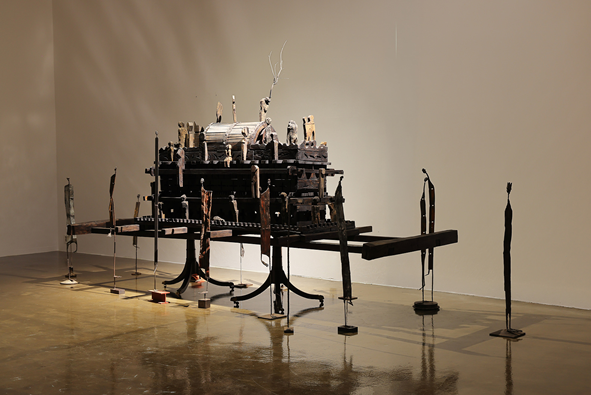
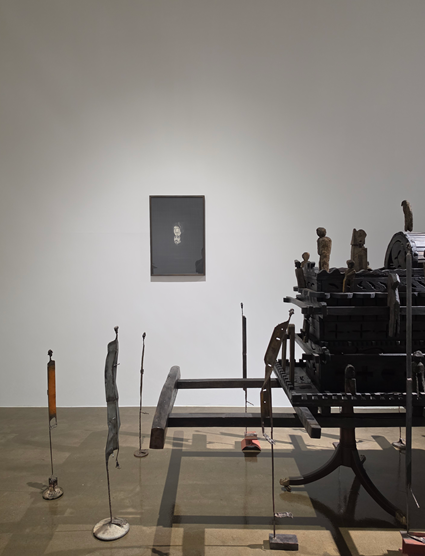
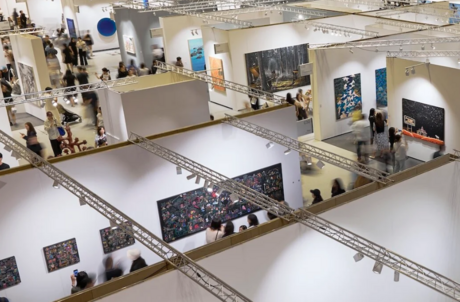
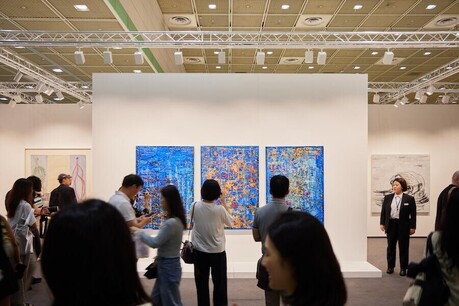
The installation view of the exhibition, Courtesy of Gallery KKI
Gallery KKI will present Lee Sang Yong’s solo exhibition “Fate, the Beginning of a Single Point” at its Paju space in Gyeonggi Province from Oct. 2 to Dec. 12.
The exhibition examines Lee’s view of fate through encounters, separations and the time accumulated within old objects. Inkstones, traditional Korean funeral biers, musical scores and drawings are brought together to show how personal memories and relationships develop into a single visual language.
For Lee, fate is not a predetermined conclusion. Each chance encounter is a point; multiple points form lines connecting the past and future, while intersecting lines create the broader structure of a life. The moment an object reaches the artist and the later moment when an artwork meets its viewer are treated as parts of the same continuing process.
Inkstones are central to Lee’s practice. They relate to memories of his father’s calligraphy and the artist’s own experience studying classical texts at a seodang, a traditional Korean school, in his twenties. Wear, stains and traces left by previous owners are retained as records rather than removed as defects.
Lee’s “Fate” series, begun in 2010, also includes works that transfer the musical notation of Beethoven’s symphonies onto tape. Notes function both as musical signs and as figures suggesting crowds, emotion, encounters and departures. The repeated labour of copying scores and drawing lines turns sound into a physical visual record.
Installations made with sangyeo, traditional funeral biers, approach death as part of life rather than an isolated ending. Art critic Ahn Hyun Jung interprets the bier as a form of final respect for the dead and a device through which equality and human dignity can be considered.
Ahn also connects the Korean word seon, meaning a line, with the identically pronounced word for goodness. Under this reading, Lee’s repeated lines are not simply formal devices but traces of an ethical attitude toward labour, objects and the world.
According to the gallery, Lee has produced about 12,000 works and more than 500 notebooks documenting his process. The exhibition brings together painting, sculpture, installation, drawing and found objects to present this wider body of work.
An opening reception will be held from 5 to 9 p.m. on Oct. 2. Gallery KKI Paju is located at 521-2 Hoedong-gil, Paju, Gyeonggi Province.
SayArt.net Maria Kim sayart2022@gmail.com
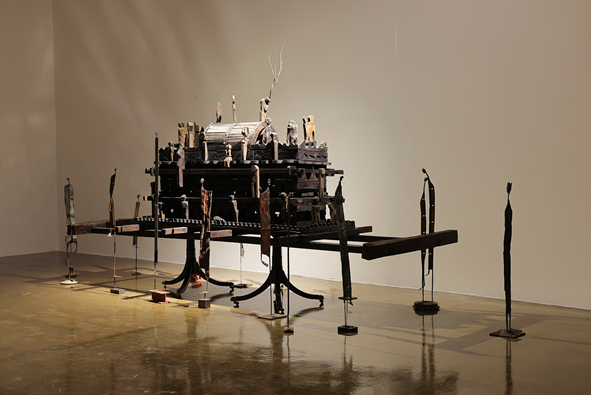
‘Fate, the Beginning of a Single Point’ will run at Gallery KKI in Paju from Oct. 2 to Dec. 12The installation view of the exhibition, Courtesy of Gallery KKI
Gallery KKI will present Lee Sang Yong’s solo exhibition “Fate, the Beginning of a Single Point” at its Paju space in Gyeonggi Province from Oct. 2 to Dec. 12.
The exhibition examines Lee’s view of fate through encounters, separations and the time accumulated within old objects. Inkstones, traditional Korean funeral biers, musical scores and drawings are brought together to show how personal memories and relationships develop into a single visual language.
For Lee, fate is not a predetermined conclusion. Each chance encounter is a point; multiple points form lines connecting the past and future, while intersecting lines create the broader structure of a life. The moment an object reaches the artist and the later moment when an artwork meets its viewer are treated as parts of the same continuing process.
Inkstones are central to Lee’s practice. They relate to memories of his father’s calligraphy and the artist’s own experience studying classical texts at a seodang, a traditional Korean school, in his twenties. Wear, stains and traces left by previous owners are retained as records rather than removed as defects.
Lee’s “Fate” series, begun in 2010, also includes works that transfer the musical notation of Beethoven’s symphonies onto tape. Notes function both as musical signs and as figures suggesting crowds, emotion, encounters and departures. The repeated labour of copying scores and drawing lines turns sound into a physical visual record.
Installations made with sangyeo, traditional funeral biers, approach death as part of life rather than an isolated ending. Art critic Ahn Hyun Jung interprets the bier as a form of final respect for the dead and a device through which equality and human dignity can be considered.
Ahn also connects the Korean word seon, meaning a line, with the identically pronounced word for goodness. Under this reading, Lee’s repeated lines are not simply formal devices but traces of an ethical attitude toward labour, objects and the world.
According to the gallery, Lee has produced about 12,000 works and more than 500 notebooks documenting his process. The exhibition brings together painting, sculpture, installation, drawing and found objects to present this wider body of work.
An opening reception will be held from 5 to 9 p.m. on Oct. 2. Gallery KKI Paju is located at 521-2 Hoedong-gil, Paju, Gyeonggi Province.
Warning: Trying to access array offset on value of type bool in /home/sayart/public_html/_libs/smarty/templates_c/103e99f6d7d08ee6b6541efd32c0ef2f33076acc_0.file.news_3t_view.tpl.php on line 56
Warning: Trying to access array offset on value of type bool in /home/sayart/public_html/_libs/smarty/templates_c/103e99f6d7d08ee6b6541efd32c0ef2f33076acc_0.file.news_3t_view.tpl.php on line 59